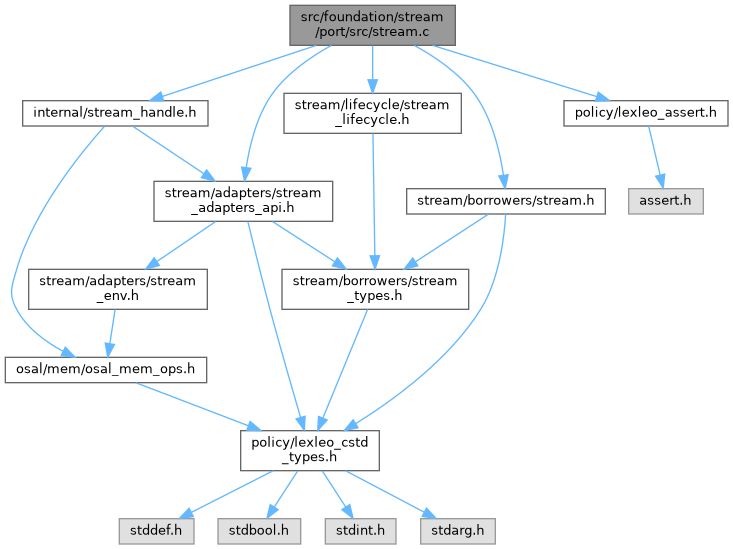
Private implementation of the stream port.
More...
Go to the source code of this file.
◆ stream_create()
This function is intended to be called by stream adapters to construct a public stream_t from:
- a dispatch table describing backend operations,
- an adapter-owned backend instance,
- an injected environment carrying runtime dependencies.
The produced stream handle takes ownership of neither the vtable nor the environment object itself; it only stores the required runtime references. The backend lifetime and close semantics are governed by the adapter contract, notably through vtbl->close.
- Parameters
-
| [out] | out | Receives the created stream handle. Must not be NULL. |
| [in] | vtbl | Backend dispatch table. Must not be NULL and must provide non-NULL operations. |
| [in] | backend | Adapter-owned backend instance to bind to the stream. May be NULL only if the resulting semantics are explicitly supported by the caller, though normal adapters are expected to provide a valid backend. |
| [in] | env | Stream environment carrying injected runtime dependencies. Must not be NULL. |
- Returns
STREAM_STATUS_OK on successSTREAM_STATUS_INVALID if arguments are invalidSTREAM_STATUS_OOM on allocation failure
- Postcondition
- On success,
*out contains a valid stream handle that must later be destroyed via stream_destroy().
Definition at line 69 of file stream.c.
◆ stream_default_env()
- Parameters
-
| [in] | mem_ops | Memory operations to expose through the returned environment. |
- Returns
- A
stream_env_t such that ret.mem == mem_ops.
- Note
- This helper does not allocate and performs no validation. It only packages the provided dependency into a public
stream_env_t.
Definition at line 132 of file stream.c.
◆ stream_default_ops()
The returned table exposes the default public borrower operations of the stream port.
- Returns
- Non-
NULL pointer to a well-formed stream_ops_t.
- Postcondition
ret->read != NULLret->write != NULLret->flush != NULL
Definition at line 123 of file stream.c.
◆ stream_destroy()
- Parameters
-
| [in,out] | s | Address of the stream handle to destroy. |
If s == NULL or *s == NULL, this function does nothing. Otherwise, it releases the stream object and sets *s to NULL.
Definition at line 98 of file stream.c.
◆ stream_flush()
- Parameters
-
| [in] | s | Stream handle to flush. |
- Returns
- Operation status.
This function exposes the borrower-facing flush operation of the stream port.
Definition at line 62 of file stream.c.
◆ stream_read()
- Parameters
-
| [in] | s | Stream handle to read from. |
| [out] | buf | Destination buffer receiving up to n bytes. |
| [in] | n | Maximum number of bytes to read. |
| [out] | st | Optional status output. |
- Returns
- Number of bytes actually read.
This function exposes the borrower-facing read operation of the stream port.
If n == 0, the function returns 0 and, when st != NULL, reports STREAM_STATUS_OK.
Definition at line 19 of file stream.c.
◆ stream_write()
- Parameters
-
| [in] | s | Stream handle to write to. |
| [in] | buf | Source buffer containing up to n bytes to write. |
| [in] | n | Maximum number of bytes to write. |
| [out] | st | Optional status output. |
- Returns
- Number of bytes actually written.
This function exposes the borrower-facing write operation of the stream port.
If n == 0, the function returns 0 and, when st != NULL, reports STREAM_STATUS_OK.
Definition at line 38 of file stream.c.


 1.9.8
1.9.8